by Barbara Croner & Sheila Joshi
The Descent Experience
Since the beginning of time, humanity has described a
particular kind of experience that many people have had, but many have not had.
It involves terrible suffering. It lasts a very long time. During much of it,
there is no help or relief that can be had. Eventually, it draws to an end,
culminating in a return to life, often with additional gifts.
It has been called The Descent Experience, and the oldest
known recorded version of a descent myth was written by the Sumerians on clay
tablets in the third millennium BCE. In
this version, the goddess Inanna (also known as Ishtar) has to visit the
Underworld. There, she is destroyed physically and psychologically in the most
gruesome way. It’s bad, no one will
help; it goes on for awhile. Finally,
Enki, the god of wisdom, comes to her rescue in an artful way, deals are made,
she is reconstituted, and returns to the world.
Maybe 1000 years later, the ancient Greeks wrote their own
descent myth about Persephone, who is abducted, raped, and held captive by
Hades, king of the Underworld. It’s bad, no one will help; it goes on awhile.
Finally, her mother Demeter pressures her father Zeus into negotiating her
release. Deals are made, she has to spend part of every year in the Underworld,
but is allowed to return to the world.
C.G. Jung – The Red Book
In 2009, the heirs of Carl Jung allowed his account of his
descent experience to be published for the first time. Over the course of many
years, from about 1914 to 1930, Jung wrote and drew about his own frightening
falling apart, during which he confronted the darkness in himself and in the
world (including WWI). He wrote and drew in order to save himself. It was bad,
there was no help. It went on a long time. Eventually, he found help from
beings he encountered in his mind who may have been parts of himself,
archetypes, and/or spirits of the dead.
Years later, he said that his most important ideas, the ones
he worked on for the rest of his life, and that we remember him for, all came
out of this period.
The Tertium Non Datur
In 1916, still early in his descent experience, Jung wrote a
paper entitled “The Transcendent Function,” which contained the seeds of some
of the most foundational ideas of his life’s work.
He introduced the term “transcendent function” to describe a
fundamental pattern in human psychology.
We are continually confronted with internal conflicts. Initially, he referred to the conflict
between the conscious ego and the unconscious, but over the decades this
concept has been applied to all kinds of psychological conflicts. Jung believed that these conflicts reflected
not only influences from our childhoods, but also a teleological pull toward
our wholeness (camilogallardo.com).
When faced with irreconcilable conflict between two needs,
the human psyche is designed to create a transcendent third option that never
existed before. This creative dynamic,
repeated throughout life, leads to ever greater individuation and
wholeness. The transcendent function is
this process. The product of the
transcendent function is called the tertium non datur.
Jung borrowed this term -- tertium non datur -- from the
field of logic in philosophy. It is the
Latin translation of a concept attributed to Aristotle, that translates as “the
third is not given” (wiki, everything2.com).
It refers to situations where there is no logical third option to
conflicting propositions, such as “Socrates is mortal. Socrates is not mortal.” There is no middle ground. (You may already be imagining how there
could be a middle ground!)
In this first 1916 essay, Jung appears to use the term
“tertium non datur” in its original sense as meaning that there is no logical
third solution to an irreconcilable conflict, while the transcendent function creates something that transcends logic
(Jung, Collected Works, Vol. 8, p. 90).
However, over the decades the usage of the phrase “tertium non datur” in
Jungian circles flipped over to refer, itself, to the magical, third way
solution that the transcendent function creates, and that’s how we will be
using it here.
Waiting: Tension and Time
There are many ills that flesh is heir to, but not all
hardships are descent experiences. A
descent experience is characterized by a long, long time of waiting while in
great tension. During it, it may seem
like none of the usual remedies work, or that sorrows come not single spies,
but in battalions. Job had a descent
experience. Nelson Mandela did. Many chronic illnesses are descent
experiences. Neurological damage
usually causes a descent experience.
Spiritual emergencies are usually a descent experience.
We humans naturally want to be able to *do* something about
our suffering. We Americans *expect* to
be able to do something about it – and pronto.
This long time of tension is, itself, a shocking experience, independent
of whatever other suffering each unique descent experience entails. How could nothing work?! Why is there not more help?! What am I doing wrong?! How on Earth could this still be
happening?! I don’t believe this is
still happening…..
There are some human experiences that, no matter what you
do, require waiting through a long time in great tension.
Why?
Because something is created by this process that would not
be created any other way at this time.
Theoretically, there is always room for improvement and for doing things
more easily in the future. We believe
everything in evolving – humans, the Tao / God / mind of the Universe, the laws
of physics, the collective unconscious.
But, at this given point in time, for this individual, and for her / his
role in the Universe, this awful, long time of great tension is what will
create what is needed.
Irreconcilable conflict
We humans are complex beings, riddled with conflicting
tendencies, conflicting needs. We rarely have one feeling at a time; we have
several, some in direct opposition to each other. We don’t just have a conscious or unconscious mind; we have
both. And so often, we have a desire,
but it is opposed or inaccessible in some way.
We humans also experience the universe around us as riddled
by conflicting tendencies. Maybe this
is just an artifact of our sensory limitations, or our bilateral symmetry, or
our being an anisogamous species that requires two sexes to reproduce. Maybe it’s an inherent dynamic of the
universe.
As early as 1700 – 1100 BCE, the ancient Indians wrote a
religious text called the Rig Veda, which talks about a fundamental cosmic
dialectic between the opposing elements of purusha (consciousness, masculine,
active) and prakriti (matter, the physical, nature, feminine, passive) (http://en.wikipedia.org/wiki/Dialectic,
http://en.wikipedia.org/wiki/Rig_Veda,
http://en.wikipedia.org/wiki/Samkhya,
http://en.wikipedia.org/wiki/Purusha,
http://en.wikipedia.org/wiki/Prakriti).
Around the 6th – 4th c BCE, the
ancient Chinese wrote a philosophical text called the Tao Te Ching, which talks
about a fundamental cosmic dialectic between the opposing forces of yin (dark,
feminine, cold, wet) and yang (light, masculine, heat, dry) (http://en.wikipedia.org/wiki/Daode_jing,
http://en.wikipedia.org/wiki/Yin-yang).
Roughly around this same time -- during the intriguing Axial
Age when humanity seemed to take a leap in its thinking, spontaneously, across
the globe -- the Book of Genesis was also produced. It is the first book of the Hebrew and Christian Bibles, and it
also talked about a fundamental cosmic dialectic between opposing forces. The first several lines are all about God
taking a void and inventing a world by creating contrast: separating heaven from earth, light from
darkness, water from dry land, male and female (http://en.wikipedia.org/wiki/Axial_Age,
http://en.wikipedia.org/wiki/Book_of_Genesis).
Those are some of the earliest records we have of this line
of human thought. Now, we’re going to
skip ahead to the Western thinker whose name has become synonymous with the
dialectic of opposites. Georg Wilhelm
Friedrich Hegel (1770 – 1831) was a German philosopher who left a legacy of
ideas that continues to be influential today.
In recent decades, the classic rendition of Hegel’s model of
thesis-antithesis-synthesis has undergone some reinterpretation, with some
scholars emphasizing that what he really said was
abstract-negative-concrete. Either way,
he was definitely trying to say something useful about the progression toward greater
knowledge. It inevitably involves
contradiction, and we should be creative about how we handle those
contradictions. In fact, the universe,
itself evolves creatively through the relationship between the contradictions.
Hegel scholars also have different views as to whether Hegel
proposed to resolve the tension of opposites through synthesis, unification,
assimilation, or transcendence. One
term Hegel used was the German word Aufhebung, which he apparently used for its
“contradictory implications of both preserving and changing, and eventually
advancement.” He also talked about the
universe as resolving “being” and “non-being” into “becoming” (http://en.wikipedia.org/wiki/Georg_Wilhelm_Friedrich_Hegel,
http://en.wikipedia.org/wiki/Dialectic,
http://en.wikipedia.org/wiki/Aufheben).
A generation or two later, Carl Jung created a brilliant
model of the psyche that placed heavy emphasis on the existence and
interrelatedness of opposites in mental life.
He believed there was no mental energy unless there was a tension of
opposites (Dotson, 1996a, 1996b). Some
of the opposites he wrote about include:
conscious / unconscious, masculine / feminine, Shadow / persona, animal
/ spiritual, extraversion / introversion, thinking / feeling, sensing /
intuiting, causality / teleology (Spencer, nd).
Jung developed the constructs of the transcendent function
and tertium non datur to understand how the essential conflicts progress. The Jungian analyst and lexicographer Daryl
Sharp writes:
“Jung's major contribution to the
psychology of conflict was his belief that it had a purpose in terms of the
self-regulation of the psyche. If the tension between the opposites can be held
in consciousness, then something will happen internally to resolve the
conflict. The solution, essentially irrational and unforeseeable, generally
appears as a new attitude toward oneself and the outer situation, together with
a sense of peace; energy previously locked up in indecision is released and the
progression of libido becomes possible” (Sharp, 1991).
The transcendent function is Jung’s name for this process,
and the tertium non datur is the result of the process.
Using the idea of the tertium
non datur to cope with a descent experience
A descent experience is profoundly unpleasant, sometimes
agonizing. By definition, there are no
easy answers. But, it may be possible
to get some relief and reassurance from viewing it as a highly productive
seedbed for innovative transformation of yourself that would not be likely to
occur any other way. Jung gave us a
useful roadmap that can make sense of the chaos of a descent experience. It shows how thinking in terms of the
transcendent function and tertium non datur, and even looking for them more
actively, can help us navigate this dark fastness.
We will now explore why the passage of so much time is
unavoidable; why tension (often in the form of pain and fear) is unavoidable;
the unpredictability of the tertium non datur; some specific implications about
neurological damage and psi; some thoughts on the relationship between the
tertium non datur and the Tao; and, finally, what comes after the arrival of
the tertium non datur.
Time (often a very long time)
is unavoidable
One of the excruciating characteristics of a descent
experience is the unbelievable amount of time it takes. Yet, we ruefully submit that this is the
very purpose of a descent experience.
The descent experience forces one to wait – none of the usual coping
strategies seem to work, and there doesn’t seem to be any way to get away from
it. If things are going along in a more
conventional manner, we have a strong tendency to keep busy and stay
distracted, and therefore certain things don't develop. But, when there is great tension over a long
time, we are forced to think differently than if things are easy and flowing.
The passage of time is required in order to generate a
really new and different creative solution – a tertium non datur – that
transcends the stuck points in one’s life-to-date. Whatever one’s personal conflicts are about – self-expression v.
loyalty, boldness v. comfort, etc. – holding the forces of opposites for an
extended period of time is what brings about evolution. Something brand new is created, something
beyond a compromise or settling. Jung
wrote:
“When there is full parity of the
opposites, attested by the ego's absolute participation in both, this necessarily
leads to a suspension of the will, for the will can no longer operate when
every motive has an equally strong countermotive. Since life cannot tolerate a
standstill, a damming up of vital energy results, and this would lead to an
insupportable condition did not the tension of opposites produce a new, uniting
function that transcends them. This function arises quite naturally from the
regression of libido caused by the blockage” (Jung, “Definitions,” CW6, par.
824, in Sharp, 1991).
A tertium non datur only emerges when time goes by, tension
builds, and energy is dammed up.
Something has to accumulate; there is no shortcut. Think of all the things that require time: many chemical reactions, including cooking
our food, or aging wine and cheese. Diamonds. You have to wait for sap to flow. Think of how seeds first go down into the
dark, unseen, grow roots, and only then sprout into the sunlight.
Some bamboo will take three years in the ground before any
visible growth appears, and then sprout and grow up to four feet in 24 hours
(Hancock, p. 181; http://www.pbs.org/wgbh/nova/lostempires/china/miracle2.html;
http://www.lewisbamboo.com/habits.html)
Even the boiling of water takes time! Andrew Holecek, a Tibetan Buddhist and
faculty member at Naropa University compared benefiting from a spiritual
practice to waiting for a pot to boil –
Science speaks about phase
transformations, or punctuated equilibrium. A common example is the manner in
which water comes to a boil. Put a pot of water on the stove, turn on the heat,
and wait. Depending on the intensity of the heat and the temperature and volume
of the water, it will boil slowly or quickly, but either way there is a period
when nothing seems to be happening. All the energy is going into the water with
no obvious result. The phase transformation from water into steam takes time.
Similarly, when we engage in
spiritual practice, we have placed ourselves on the stove and turned on the
heat. If our practice is halfhearted, then it takes time for that low
temperature to transform us. If we practice wholeheartedly, the higher
temperature brings us more rapidly to a boil. Either way there is a period when
nothing seems to be happening. Lots of energy is going into our practice, but
nothing is cooking.
As long-term practitioners reflect
over years of practice, they discover they are starting to get warm. The
changes come slowly because the water that is being heated is so cold, and the
heart of our practice is usually tepid. But sooner or later we come to a boil.
After years of practice we “suddenly” transform from an uptight, aloof person
into an open, loving one; from a confused sentient being into an awakened one.
Lasting spiritual changes arise
from simply being present, again and again. Religion means to link (ligio) back
(re). Linking back on the spiritual path takes place every time we return to
our breath, our body, our mantra, or the present moment. With each return we are
taking a small step toward enlightenment because being fully present is a
fundamental expression of enlightenment (Holocek, 2009).
A descent experience has much in common with any deep
spiritual practice, but it is usually more painful and less rewarding for
awhile.
There are many things that can’t be sped up. Time cannot necessarily be replaced by
greater intensity. You can’t force a
caterpillar to become a butterfly faster.
It takes time to get to know who another person really is. You have to wait to see the pattern of their
approach to various situations over time.
It is very hard for us to wait in modern Western societies,
perhaps hardest of all in the US. There
is tremendous cultural pressure to do more and to do it faster. There’s something wrong with you if you’re
not doing a lot, and doing it at the speed of a quantum computer. Descent experiences have always been hard,
as the Sumerians told us in the third millennium BCE, but never before have they
been so counter to the zeitgeist.
Leave it to the Italians to help us with this problem! There is an Italian musical term, Tempo
giusto, that instructs the musician to play the piece at the right tempo. Some interpret this as a strict adherence to
the metre, but some interpret it as an invitation for the musician to use
personal intuition “to figure out the tempo that the notes in the score imply.
In this sense tempo giusto….can only be [found] on a case-by-case basis by
examining the overall character of a composition. It is a speed the musician
intuits from the structure and nature of the piece itself” (http://en.wikipedia.org/wiki/Tempo_giusto).
The Canadian journalist Carl Honoré (2004) has seized upon
this infrequently used musical term and borrowed it for his book and mission,
In Praise of Slowness: Challenging the Cult of Speed, which are about helping
us hectic modern people to re-find a more natural and human tempo for
living. Painful and coercive as the
descent experience is, one of its purposes is to bring us to the tempo giusto.
There in an irony having to do with the descent experience
and time which we wish to mention.
During a descent experience, some people find that they are growing,
learning, and changing incredibly fast, and yet their overall quality of life –
which may involve illness, poverty, imprisonment, war -- remains absolutely
stuck. The lack of synchronization
between personal effort and internal development on the one hand and external
lived reality on the other can be crazy-making and depressing. It will probably be very different from how
your life was before the descent experience, when there was much more of a
correlation between effort and results.
It is perhaps cold comfort, but still it is true that our
experience of time is just one aspect of the whole truth about time. The physicists, parapsychologists, and psi /
spiritual experiencers tell us that there is no time, or all time exists now,
or the arrow of time can go backwards, or time really can change its pace. But, frankly, one of the hallmarks of a
descent experience is that, whatever the heck is happening with time, you’re in
a bad neighborhood of it.
In the Fall of 2010, Jack Kornfield, Ph.D., psychologist and
Buddhist monk, spoke at one of The Red Book Dialogues in San Francisco. In
discussing Jung’s descent, and descent experiences in general, he said your
worst fears are the gateway to your enlightenment. You must face them, you must
suffer, yet you must not get lost in the experience either. You stay present to
your fears, you wait, you listen. It can take a long time. If you can trust the
desert, at some point, it rains. Then, you find out what your gift, your
contribution to the world is, "some new extraordinary wholeness appears
and that's who you really are."
So, time will eventually be your friend again. Let us now take up the issue of this fear
that Kornfield mentions.
Tension (often in the form of
pain and fear) is unavoidable
Ah….pain and fear….these are the very worst aspects of a
descent experience, but keep reading because we hope to give you some thoughts
to help you with them.
As a disclaimer at the beginning, we wish to say that we
believe the human trajectory is toward growth with less suffering. There has been a slow shift over the course
of human history away from shame, guilt, submission to authority, caste and
class assignment, and the general belief that we must and should suffer. There is also an explosion of knowledge and
information-sharing going on, in every subject, including psi and communication
with Spirit. The Aquarian age will be
an advance over the Piscean age in terms of the mitigation of human suffering.
However, at this point in our development as a species, some
of us still are going to go through harrowing descent experiences. And to a lesser extent, some tension will
probably always be a part of human development.
Tension inevitable to psychological development
Throughout his writings, Jung repeatedly refers to tension
as an inevitable part of psychological life and development. He thought of the conflict of opposites and
the resolution of that conflict as an ongoing aspect of normal
development. He called the resolution
of that conflict the transcendent function, because he believed it had to
transcend logic and reason to be a fully satisfactory resolution. The Jungian lexicographer Daryl Sharp
writes: “The transcendent function is
essentially an aspect of the self-regulation of the psyche” (Sharp, 1991).
Tension particularly present in pursuing central life
mission
If tension is an inevitable part of psychological life, it
is even more present whenever you are working on something that is more central
to your purpose in life. The
psychologist and dream specialist Gillian Holloway writes in two excellent blog
posts about the relationship between our truest destiny and our deepest
fears.
She has found in her practice that when people pursue their
most compelling mission, they are often beset by their own personal worst
fears, almost as if this were by design.
She doesn’t claim to know why this is, but she encourages us not to back
off from our mission, and assures us that the fears are not a sign that we
should give up (Holloway, http://www.flashofspirit.com/blog/2012/09/why-life-purpose-is-so-tricky/).
Holloway also has observed that developmental steps that
increase one’s power or one’s voice tend to be fraught with obstacles. Again, she adjures us not to take this as a
sign that we are on the wrong track.
Goals associated with power
are fraught with challenges the like of
which you may never see elsewhere….If your goal will give you more power, even
if you are not doing it for the power, expect
the process to be filled with weird hazards….These problems are not a sign you
should quit. Keep at it and don’t let the flying debris hit you in the head.
Consider this an initiation or ordeal.
And --
Goals related to your voice are
highly challenging. There is nothing more taboo than your authentic voice. It
freaks out the people close to you, and it ticks off the “experts” who should
be helping you.
And –
Be aware of “difficulty at the
beginning.” There is a Zen principle about “difficulty at the beginning.” Very
loosely, this translates into finding out that your idea was dumb, not
possible, not practical, won’t pay, or is not open to people who are not
already doing it. This is like a weather pattern that smacks down new ideas.
Just realize this is the way of it, not the truth of it. Be rather stubborn
about the “no’s” you encounter at the beginning, because they can refine your
plan, but should not nullify your intention.
Be aware of “dragons at the gate.”
When you move toward something that has been a dream of yours, a passionate
hope, or something you’ve worked toward for a long time, monsters will jump out
at you from every side, saying you lack the right credentials, “it takes a lot
of money,” or it simply can’t be done! The closer you get to the finish line of
your heart’s desire, the more dragons will threaten you. This just means you’re
getting there. Offer the dragons a breath mint and press on!
If you have fears about a project
or goal, those fears will be out-pictured in your life. Working on something
connected to private fears will magically attract nay-sayers, critics, or
technical experts who will pick at you or flatly tell you why it can’t be done.
Those critics and experts are not signs that you should give up. Instead, they are
your fears being “presented” so that you can chose to keep at it. Go ahead and
put your thumb to your nose and wiggle the fingers of your hand at them. Then
do the next step. This can actually get to be fun. The more something means to
you, the more it relates to your voice, your spirit, your purpose, the more
fears may be woven around it, and thus, the more silly critics may jump out of
the woodwork and say “boo.” Don’t let them scare you. They are part of the
game. Give them your raspberry salute and plunge ahead!
Be willing to let go of the form,
but not the essence. The person you loved may flee the scene, but don’t give up
on love. The job you thought you wanted may be snatched from underneath you,
but that doesn’t mean you won’t be a success. The house you made an offer on
may get sold to another, but you still can and will find the perfect home.
Separate from the forms when they leave or don’t work out, but deepen your
connection to the essence. You haven’t been told “no,” you are simply letting the
“not quite right” forms fall away.
http://www.flashofspirit.com/blog/2012/08/are-those-obstacles-a-message/
These observations of Holloway’s are based on 25 years of
helping clients and students. She is
saying that there is some sort of role for difficulties, for tension, in the
unfolding of central life purpose.
Tension in the form of fear and pain seems to be an inevitable part of
the process.
Tension
in the midlife developmental passage
A descent experience can happen at any stage of life, but it
is most likely to happen in midlife.
Jung contributed greatly to the understanding of individuation, which is
the process of differentiation from others, of developing one’s unique
personality (Sharp, 1991). Although it
is a lifelong project, Jung gave a lot of attention to the big leap of
individuation that happens in midlife, which is sometimes very disruptive and
distressing.
In an excellent article on the midlife crisis, which
incorporates Jungian and astrological concepts, astrologer Candy Hillenbrand
writes that the task of midlife is to shift from an identification with ego and
persona more towards an identification with one’s Self. For our purposes, the Jungian construct of
the capital-S Self may be thought of as the greater self that encompasses ego
and soul or higher self.
The midlife task also entails incorporating whatever
polarities one has not focused on in the first half of life. For example, feminine qualities must be
augmented by masculine qualities, and vice versa; creative qualities are to be
augmented by analytic ones; introversion by extroversion; etc.
The purpose of this shift to the greater Self and to
encompassing one’s heretofore less developed capacities is to make it possible
to achieve what you really want to do with this life. As you can see, moving toward the less developed polarities in
your personality will intensify that tension of opposites that calls upon the
transcendent function to produce its tertium non datur. You can also see the tension inherent in
shifting from ego and persona to greater Self because it involves breaking more
than ever with familial and cultural expectations.
Reconciling newly clamoring opposites within yourself and
breaking old loyalties often leads to turmoil.
As Hillenbrand writes: “…the
process involved can be a long and arduous one, and along the path we are
likely to encounter all the 'demons' of the past, our deepest fears and
insecurities, and in the chaos that can ensue, we may be forced to endure long
nights of pain, grief and sadness….” (Hillenbrand, 1997/8).
Although the midlife passage inevitably involves some
tension, not all midlife passages are descent experiences. And, again, not all descent experiences
happen at midlife. But, many descent
experiences do happen around midlife and involve a spiritual awakening.
Tension
in the descent experience: crucifixion
In this section, we have discussed the inevitability of
tension in everyday psychological development; in nearing one’s central life
purpose; and in the midlife developmental passage. Unfortunately, it is still true that tension reaches even more
epic proportions in a descent experience.
In fact, crucifixion is an apt metaphor for the descent experience, and
this archetype is explored beautifully in an exceptional online book
(2000-2003) by Ann K. Elliott, the progressive, environmentalist, Jungian,
Christian scholar. The book is
entitled: The Christian mysteries as
the soul's seven-stage journey to higher ground: Imaged through the pivotal events in the life of Christ according
to Jungian psychology, Teilhard de Chardin's evolutionary vision & Sri
Aurobindo's Vedic ordering of consciousness.
Jung believed that in sorting out the dark and light within
our natures, and finding our own mature, individuated path, we would all have a
psychological / spiritual experience tantamount to crucifixion: “We all have to be ‘crucified with
Christ,’…suspended in a moral suffering equivalent to veritable crucifixion”
(Jung, CW12, 1944/1968).
Elliott agrees that finding one’s own center, and daring to
separate from the rules and beliefs of others, can be as agonizing as a
crucifixion. Shifting from a stronger
identification with your ego to a stronger identification with your Self
necessitates breaks with family and culture.
The cruciform archetype captures this tension between ego and Self, and
also the tension between our physical and transpersonal nature.
Elliott writes about the developmental inevitability of
agony:
Normally it takes some kind of
conflict or pressure to give rise to a new degree of consciousness. Ordinarily this comes about as one
“agonizes” or is extremely anxious about something, or concerning which one
suffers relentlessly recurring anxiety attacks. The agony of the struggle becomes the crucible in which the new
measure of consciousness is separated out and contained. It becomes the empty, hollowed-out place
into which God, light, consciousness can enter (Elliott, 2000-3).
And the cross as symbol of the psyche:
[C]arrying our own cross is a
symbol for carrying our own psyche, hence for individuation. Individuation requires us to carry the
burden of our personalities and our lives consciously and courageously (Sanford
in Elliott, 2000-3).
What it means to embrace the cross:
Psychologically understood, to
embrace the cross is to live from the center in obedience to the inner voice of
Self and in full acceptance of who one is called to be and what one is called
to do (Elliott, 2000-3).
Individuation and the cross:
The discovery of “one’s own
particular pattern of wholeness” is what Jung intends by individuation. In a spiritual sense, embracing the cross is
a matter of accepting one’s unique and infinite worth in the eyes of God. In a psychological sense the task is to
discover one’s innermost creative center and live life from there--not striving
to be more or settling for less (Elliott, 2000-3).
The tension between the ego and the Self:
As the work of transformation
progresses, the ego’s role as the center of consciousness is threatened by the
Self’s higher authority as the center of the total psyche. As the tension between ego and Self mounts a
soul crisis develops which Jung above describes as “a moral suffering
equivalent to veritable crucifixion.”
Just as surely as the Incarnation led to the Crucifixion, so in everyone
the tensions inherent between “spirit” and “flesh” become the vertical and
horizontal bars of the cross upon which human nature hangs. In the process of the second or spiritual
re-birth, the ego must endure the subjective, emotional pain of its own
crucifixion. Psychologically defined,
crucifixion is the death of the ego’s will to rule; while resurrection is the
maturation of the transcendent Self whose will is in accordance with the divine
will. As crucifixion is the price
exacted from the ego and its self-will, so rebirth is the promise of the Self’s
new transcendent identity (Elliott, 2000-3).
Jung and Elliott also had some interesting things to say
about the two thieves who were crucified alongside Jesus. One thief denies any responsibility for his
own fate and scorns Jesus, while the other thief takes responsibility for his
fate and acknowledges Jesus. It is not
entirely clear to us whether Jung thought of the two thieves as symbolizing the
light and dark in our nature, or whether he thought of them as symbolizing the
ego and the Self, or whether he had both meanings in mind. Either way, he avers that they symbolize an
“agonizing suspension between irreconcilable opposites” which, as we now know,
he believed would require the transcendent function to resolve and a tertium
non datur in order to resolve it (Jung, 1951 / 1959, CW 9, para 79).
Elliott casts the two thieves as the conflict between the
ego and the Self with Jesus trying to reconcile the two within himself
(Elliott, 2000-2003). Note that the ego
is never left behind. It must always
exist and be strong. It creates the
holding environment for the transcendent function and we need it for
everything. Jung stressed that
development works better when the conflicts are made conscious and held by the
ego: “At this stage it is no longer the
unconscious that takes the lead, but the ego” (Jung, CW8, par. 181 in Sharp,
1991).
The purposes of extreme tension
In a simple way, tension is a signal that something needs
attention, solution, help, healing, empathy.
You would not notice or work on that something if it weren't in
tension. But tension is much more than
that. It is especially fundamental to
creation – the creation of any kind of psychological existence, and the
creation of real greatness within us.
It seems that there must be some kind of opposition or meeting between
two forces for new things to emerge.
Consider the hologram as a metaphor. A hologram is made by taking a coherent
light beam, splitting it, reflecting half onto an object and then holographic
film, and the other half directly onto the holographic film. The split beam comes back together and
creates a 3D image. Perhaps the pure
consciousness we are born with has to be split or differentiated in order to
again meet itself, know itself, give us new perspectives, evolve and
create. We start as pure light, become
differentiated, but may lose parts of ourselves along the way, and then have to
bring all the parts back together to make a magical 3D version of ourselves.
Jung wrote: “There
is no consciousness without discrimination of opposites” (Jung, 1951 / 1959,
Psychological Aspects of the Mother Archetype, CW 9i, par. 178 in Sharp 1991).
Furthermore, Jung believed that when you have intolerable,
irreconcilable conflicts, that's when something really exceptional is
created. “The greater the tension
between the pairs of opposites, the greater will be the energy that comes from
them” (Jung, On Psychic Energy, CW 8, par. 49).
The struggle makes something different be born than would
have been born if there had not been a conflict between irreconcilable
differences. The Jungian
psychotherapist and actor Camilo Gallardo writes that the transcendent function
“unites the opposites for a new attitude to emerge or it can be seen more
archetypally as our relationship or interaction with the unknown or other”
(camilogallardo.com). And Jungian
lexicographer Daryl Sharp adds: “This
process requires an ego that can maintain its standpoint in face of the
counterposition of the unconscious. Both are of equal value. The confrontation
between the two generates a tension charged with energy and creates a living,
third essence” (Sharp, 1991).
The tension is a unique experience – it creates a
spirituality and a life force of its own during the waiting process. But, in the middle of that process, it can
feel like nothing is happening despite great effort, and that you are completely
thwarted. There is a paradox – a
descent experience creates deep learning experiences about the self, self-love,
passions, life-force, life. Yet, during all that learning, you can still be in
outer darkness for a very long time.
You may think, “What am I doing wrong?
Why the hell haven't I found the light?
Have I been abandoned?”
In conclusion, what we have been broadly calling tension,
but which often comes down to real fear, is a necessary part of the alchemical
process. It is essential to the
chemical reaction of irreconcilable differences. It’s terrible, but it's there for a purpose. Fear and time are essential to the
transmutation.
Once you have done everything wholesome you can think of to
be safe, healthy, and happy, you must sit with the remaining tension or fear,
maybe for a long time, and not short-circuit the process, despite the immense
temptation to do so. “Holding the
tension between opposites requires patience and a strong ego, otherwise a
decision will be made out of desperation. Then the opposites will be
constellated even more strongly and the conflict will continue with renewed
force” (Sharp, 1991).
But, if you withstand the tension, a tertium non datur will
emerge, “forcing the energy of the opposites into a common channel. The
standstill is overcome and life can flow on with renewed power towards new
goals” (Jung, CW 8, par. 827 in Sharp, 1991).
The tertium non datur is
unpredictable, irrational, and transcendent
And now for the good news.
Certainly, the most enjoyable part of this arduous experience is that
the solution to the impasse turns out to be something better than we could ever
have expected. Remember we discussed
earlier that Jung named it the “transcendent function” because it transcends
logic, and the historical roots of the term “tertium non datur” speak
explicitly to the fact that there is no logical, expectable resolution to a
given conflict.
Not only does the tertium non datur transcend logic, it
transcends familiar reality. We have
only touched lightly on psi, spirituality, and transpersonal psychology in this
essay, but let us just mention in passing that Jung thought of the Self as a
transpersonal phenomenon, something akin to a soul or higher self. (He, himself, had a very elaborate near
death experience, during which he learned a lot about other parts of
reality.) So, his use of the term
“transcendent function” also referred to his belief that the solution to
irreconcilable psychological conflicts entailed something beyond personal
psychology and physical reality.
As psychologist Jeffrey Miller writes in his book on the
transcendent function: “Though we
normally think of the transcendent function as a personal, intrapsychic
phenomenon, it is much more. Since
psyche is transpersonal, so are the presence and effects of the transcendent
function” (Miller, 2004, p. 128).
The tertium non datur is unpredictable and unexpected. As far as we can see consciously, our
conflict is irreconcilable. There is no
solution that we can imagine. So, one
of the wonderful hallmarks of the tertium non datur is its unexpectedness. As the spiritual novelist Bill Douglas puts
it, when his characters must urgently interpret too little information, they
had to allow “their minds to fall away from logic and toward deeper patterns,
more elegant and complex than linear thought was capable of processing"
(Douglas, 2011, p. 318).
Jung wrote:
As a rule it occurs when the
analysis has constellated the opposites so powerfully that a union or synthesis
of the personality becomes an imperative necessity. . . . [This situation]
requires a real solution and necessitates a third thing in which the opposites
can unite. Here the logic of the intellect usually fails, for in a logical
antithesis there is no third. The “solvent” can only be of an irrational
nature. In nature the resolution of opposites is always an energic process…”
(Jung, The Conjunction, CW 14, par. 705, in Sharp, 1991).
We have both been in descent experiences for the last few
years. While we think it’s essential to
work consistently at maintaining our lives, and learning, and trying to be more
conscious, we have come to recognize that the events -- both external and
intrapsychic -- that seem to be the stepping stones out of the descent are most
likely to come from out of the blue and could not have been anticipated despite
our keen efforts to do so!
Some thoughts on neurological
damage and psi
One example of a descent experience and irreconcilable
conflict with which we are very familiar is that of neurological damage and
psi. There is a pandemic of
neurological damage and disorder going on due to the Iraq and Afghanistan wars;
the creation of new, powerful prescription medications in every category that
have neuro-toxic side effects; and the increasing environmental toxic
load. We believe that this surge in
neurological vulnerability is being enlisted by Gaia and the Tao as an
opportunity to jump start a widespread reconnection with our innate psi.
Psi, the ability to know and affect things across time and
space beyond the reach of our senses and body, has been pushed into the
collective and individual unconscious for millennia. Now, it takes great effort for most people to re-integrate it
into their conscious experience. Yet,
it is our normal birthright, and to live without it is to live artificially
constrained. And, some people think we
cannot afford to be artificially constrained if we are to salvage life on
Earth. Biologist Lyall Watson: “As man uses up the resources of the world,
he is going to have to rely more and more on his own. Many of these are at the moment concealed in the occult – a word
that simply means ‘secret knowledge’ and is a very good description of
something we have known all along but have been hiding from ourselves” (Watson,
1973, p. xi). And psychiatrist
Stanislav Grof: “A radical inner
transformation and rise to a new level of consciousness might be the only real
hope we have in the current global crisis brought on by the dominance of the
Western mechanistic paradigm” (Grof in Peirce, 2009, p. xx).
Neurological damage often creates a descent experience. A descent caused by neurological damage may
be thought of a particular type of distressing spiritually transformative
experience. As was mentioned earlier in
Ann Elliott’s discussion of the crucifixion archetype, tension between our
physical nature and our spiritual nature / consciousness is a classic
developmental duel, but in the case of neurological damage, that tension has
reached catastrophic proportions.
In the field of parapsychology, neurological incidents have
long been anecdotally linked to psi openings.
We are still in the preliminary stage of understanding why this is.
One way to look at the relationship between neurological
damage and psi is that they are in irreconcilable conflict with each other, and
require the transcendent function to arrive at a tertium non datur. “Being very psychic,” or, more accurately,
“being very conscious of psi and integrating it into your life to a highly
developed degree” seems to be on the opposite end of the spectrum of human
health and prowess from having “brain damage.”
Yet we assume that both are present at the same time in
cases of neurological damage, since we subscribe to James Carpenter’s First
Sight model and believe that psi is an inherent, foundational way that we
interact with reality all the time. It
just tends to be unconscious and unrefined in most of us.
So you have a person who is experiencing the profound
physical, cognitive, and emotional dislocation of neurological damage and
recovery, who is also automatically equipped to draw information from any place
and any time and to affect matters beyond physical reach, but they either don’t
know this at all, or are only beginning to suspect it, or believe it, but still
can’t make it operate very well.
How do you move through this ironic paradox, this thwarting
impasse? You “work your steps,” as they
say in the recovery community, with exercise, study, healing practices,
etc. This is all helpful and
expediting, but the tension must still be borne for some time. At long last, a tertium non datur will arise
that never could have been anticipated.
Laura Bruno, the TBI survivor and medical intuitive is a
good example of this. After a car
accident, she had debilitating neurological damage, and mostly had to sit or
lie and do nothing for the first year or so of recovery. Among other symptoms, she had pernicious
migraines. At some point, she started
having sudden, unsought, accurate intuitions about the medical conditions of
others. She found that the migraines
would grow worse if she kept the intuitions to herself, and the migraines would
abate if she told the intuition to the intended recipient. She went on to heal fully, and change career
paths from English Lit academic to medical intuitive – something which never
would have crossed her mind before the neurological accident (http://neuroscienceandpsi.blogspot.com/2012/04/laura-bruno-tbi-survivor-medical.html).
Some thoughts on the Tao and
the tertium non datur
In this essay, we have focused on a particular kind of human
experience, but Jung did state that the transcendent function and its resulting
tertium non datur are integral to all psychological development all throughout
life. The magical quality of the
tertium non datur just becomes even more evident when the human condition is
more severe.
Likewise, the transcendent function and resulting tertium
non datur are characteristic of how the Tao works. But when the tertium non datur has a particularly impressive
quality, you get the sense that you are seeing the workings of the Tao more
clearly than usual.
We humans are still groping to understand whether the Tao or
God or the mind of the universe exists, how it works, and how best to work with
it. But, there have been many different
streams of thought that suggest that there is intelligence, plan, and order,
and that we do best when we try to discern that and align ourselves with it.
We are talking about creation here. You find yourself at an impasse. You´ve tried everything you can think
of. You desperately need a solution,
yet you have none. You have
nothing. It is out of the nothingness
that the tertium non datur eventually emerges, as if something were created in
the zero point field of infinite, unformed, untapped potential.
Unexpected, elegant solutions from out of the blue are the
hallmark of how the Tao works. The Tao
seems to be particularly associated with tertium non daturs -- taking
irreconcilable conflicts and co-creating with you a third, brand new way.
David Sunfellow, the Founder of NewHeavenNewEarth, wrote:
Finally, while classic
enlightenment experiences lead one to believe that there is nothing new under
the sun — that the Ground of Being is all there really is and It is eternal and
unchanging — I’ve also come to believe that brand new experiences, on all
levels, are actually unfolding as we (and the created universe) evolve. While
this is plainly obvious on the physical level, I think it is also true on the
spiritual level (Sunfellow, 2011,
http://nhne-pulse.org/the-purpose-of-life-jesus-ndes/).
In order to create something really new for you, and perhaps
new for others as well, you have to be open to the unknown. You have to hold the tension (aka fear) and
the time. With age and experience you
get better at this, and better at keeping a lookout for the tertium non datur.
One of the reasons the tertium non datur is so enigmatic and
hard to anticipate is that it reconciles parts of the self that are more
conscious with parts that are less conscious.
The less conscious parts include the greater Self or soul and the Shadow
or parts of ourselves we feel uncomfortable with (which can be both “negative”
and “positive”). With age and
experience, we also get better at knowing and holding these different parts of
ourselves.
Indeed, this is the quintessential human struggle – the
struggle to be who we’re really supposed to be, and not just who we might have
thought we were. And key to finding /
making deeper meaning in our lives is being able to go through all the
paradoxes, contradictions, and conflicts of our inner and outer worlds. The tertium non datur specializes in
navigating paradox.
Furthermore, by going through a lot of encounters with the
tertium non datur, you become more of a co-creator with the universe. You learn better how to dance with the Tao,
when to lead and when to follow, when to try hard and when to surrender. You even come to expect the unexpected.
The **Ascent** Experience and
the Spiral
Descent experiences come to an end. If you are in one as you read this, they
really do. We have read countless
stories of descent experiences, and the similarities are so striking,
regardless of the cause. People often
report a period of “ascent” when things have started to change for the better,
but are still hard, followed by arrival at a new stage of their lives where
they are astounded to encounter an unprecedented peace and ease.
Katabasis is the ancient Greek word for a descent, and
anabasis is the ascent. The oldest
myths of descent always lead to an ascent to a new life.
Ann K. Elliott, the Jungian Christian scholar, writes about
the ascension that follows crucifixion and descent. She notes that in the Bible, in Jungian theory, and in her own
dreams, spirals and spinning movement appear as symbols of ascension (Elliott,
2000-3).
Jungian Analyst Martha Blake also notes that many different
ancient traditions speak of a primal spiral creative force, and furthermore
characterize it as feminine.
Interestingly, she writes that the ancient Greek natural philosopher
Anaxagoras hypothesized that order was brought out of original chaos by a
rotational force and by the interaction of opposites (Blake, http://www.marthablake.com/tornado.html). You can see how this jibes with the
transcendent function and the tertium non datur.
Blake goes on to cite Jungian Analyst Neil Russack as having
written that: “Spirals may signify
equilibrium in a state of disequilibrium, the stability of being contained in
the womb of change, growth that retains ultimate shape, and thus permanence
despite its asymmetry.” And Blake
quotes Jung: “The spiral in psychology
means that when you make a spiral you always come over the same point where you
have been before, but never really the same, it is above or below, inside,
outside, so it means growth.”
Spiraling, rotating movement is apparent at all levels of
the physical universe. (See section on
“spin” here
http://neuroscienceandpsi.blogspot.com/2012/06/interview-with-rosalyn-bruyere.html).
In a seminar given in the 1930s, while discussing a dream,
Jung explains:
Dr. Jung: Yes, and moreover, the very symbol of unfolding and the beginning
of development follows the law of the spiral:
a plant grows in a spiral, and the buds or the beginnings of leaves are
arranged in a spiral. It is, as Dr.
Barker points out, the functioning of opposites, the reconciliation of
opposites. The man who discovered the
mathematical law of the spiral [Jacob Bernoulli] is buried in my native town,
Basel, and on his tombstone a spiral is carved with this very significant and
beautiful inscription: “eadem mutata resergo,”
which means, literally translated: in
an identical way, changed, I lift myself up.
It is a circular movement with a slight lift which produces the spiral.
Dr. Baynes: Is it the reconciliation of the idea of
change and the idea of sameness?
Dr. Jung: Exactly. The spiral moves
away from the original place to another, yet it always returns to the same
place, but just a fraction above; always moving away and always coming to the
same. Sameness, non-sameness. So the spiral is really a very apt symbol to
express development. You see, this
vision says: if you surrender to the
terror of the blood, you will discover that it leads to development; instead of
leading down into hell, it leads upwards (Jung, Douglas, & Foote, 1997, p.
243).
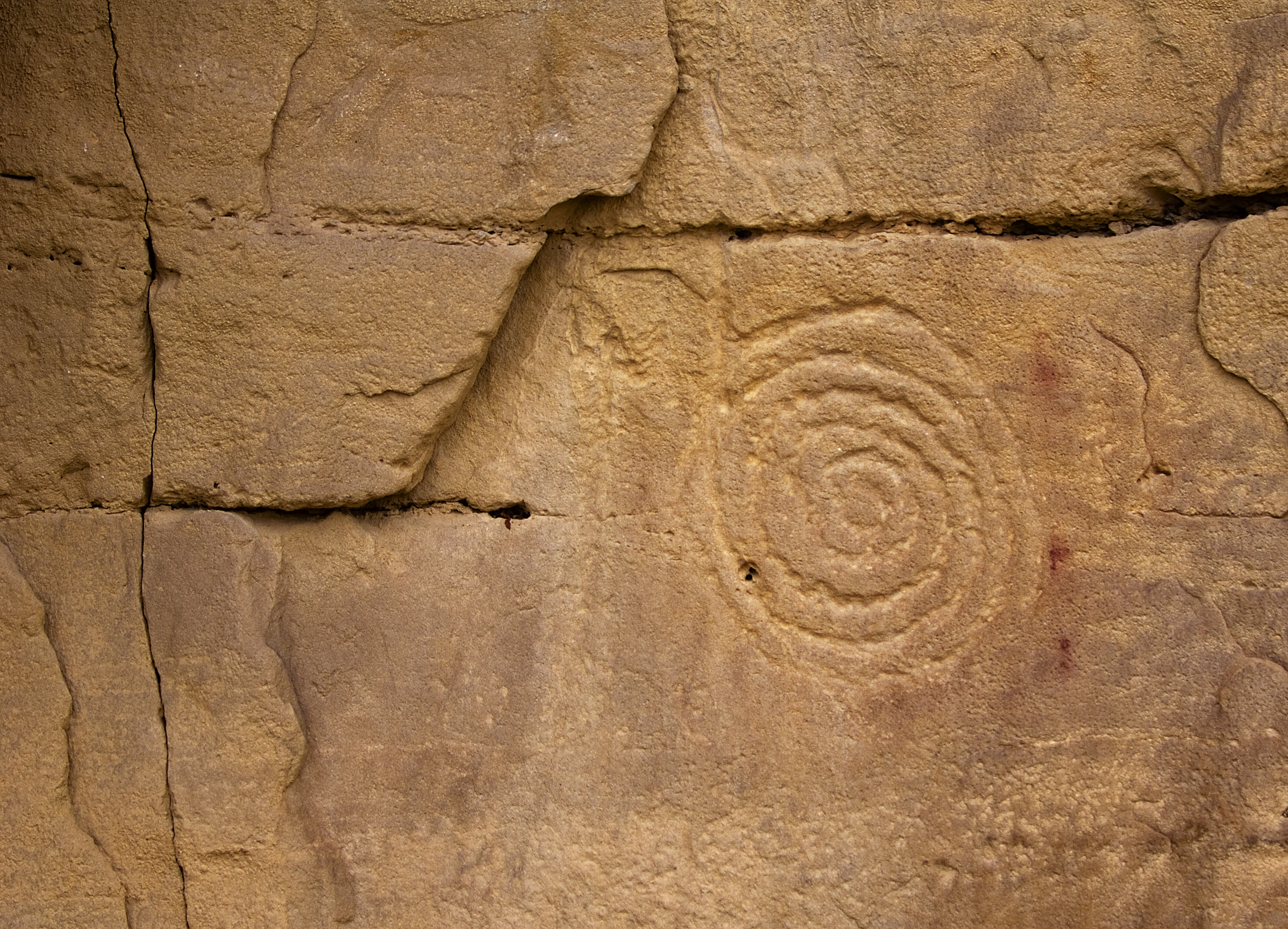 |
| Spiral petroglyph -- Chaco Canyon |
The Fourth Protocol
Finally, after a period of ascension, we arrive a new stage
of life, a new level of stable identity.
After tolerating irreconcilable conflict, and after achieving the
transcendent third, we arrive at a state of integration and stability.
Jung observed this progression, and used an alchemical
metaphor to capture it. The “Axiom of
Maria” is an alchemical principle attributed to an early woman alchemist
that: "One becomes two, two
becomes three, and out of the third comes the one as the fourth." Jungian Analyst Lara Newton writes that this
precept “speaks of the alchemical procedures which unite and separate,
procedures that are to be performed again and again to the same substance
(using the sun, using divine water, using sulphur or mercury) — each time the
procedure is followed brings us closer to the state of perfection that all
alchemists seek” (Newton, 2012).
According to the Jungian Analyst and lexicographer Daryl
Sharp:
Jung used the axiom of Maria as a
metaphor for the whole process of individuation. One is the original state of
unconscious wholeness; two signifies the conflict between opposites; three
points to a potential resolution; the third is the transcendent function; and
the one as the fourth is a transformed state of consciousness, relatively whole
and at peace” (Sharp, 1991).
As an illustration of this model, Jung had a fascinating
critique of the Christian trinity of Father, Son, and Holy Spirit. He saw it as being incomplete until it
incorporated the feminine and chthonic principles as well, and thus became a
quaternity. Not surprisingly, he
believed that true psychological health required the acceptance of the
underworld, Shadow, evil, or Satan in all of us. And, as for the importance of the feminine (and masculine) for
everyone, he actually wrote a letter of congratulation to Pope Pius XII in 1950
when the Catholic Church officially proclaimed that the Blessed Virgin Mary had
been assumed bodily into heaven, thus adding the feminine principle to the
Trinity (Brabazon, 2002;
http://en.wikipedia.org/wiki/Jungian_interpretation_of_religion).
Mary may have been taken up into heaven, but for us the
fourth, the quaternity, speaks to reaching a little bit of heaven here on Earth. It stands for the archetypal human
experience of arrival at a longed-for destination of wholeness and peace. It’s a reminder that this is possible and
that it happens and that other humans have described it. If you are not in such a place now, if you
never have been, it is hard to believe this is not pie in the sky. Certainly, one does not ever stop growing,
learning, evolving, maturing, so life does not become static and unchanging at
some point. But there is a enormous
variety of human experience, and one of the things that is possible is to feel
“arrived,” and this is what descent experiences are designed *for*.
=================
Sources:
Brabazon, M.
(2002). Carl Jung and the
trinitarian self. Quodlibet Journal, v.
4, n. 2-3. http://www.quodlibet.net/articles/brabazon-jung.shtml
Dotson, M.L. (1996a).
Jung and Heraclitus.
http://members.core.com/~ascensus/docs/jung2.html
Dotson, M.L.
(1996b). Jung and alchemy.
http://members.core.com/~ascensus/docs/jung3.html
Douglas, B.
(2001). Conspiracy of
spirits: Wall Street vs. the 99%. Illumination Corporation Publishing.
Elliott, A.K.
(2000-2003). The Christian
mysteries as the soul's seven-stage journey to higher ground: Imaged through the pivotal events in the
life of Christ according to Jungian
psychology, Teilhard de Chardin's evolutionary vision & Sri Aurobindo's
Vedic ordering of consciousness. Online
book. Cited here:
The crucifixion. http://murraycreek.net/higher/chapter4.htm
The ascension.
http://murraycreek.net/higher/chapter7.htm
Gallardo, C.
(nd). The mechanics of the
transcendent function.
http://www.camilogallardo.com/index.php?option=com_content&view=article&id=23&Itemid=26
Hancock, M.
(2011). The medium next
door: Adventures of a real-life ghost
whisperer.
Deerfield Beach, Florida:
Health Communications, Inc.
Hillenbrand, C.
(1997 & 1998). The quest for
soul at midlife. Federation of
Australian Astrologers Journal, 28.
http://www.aplaceinspace.net/Pages/CandyMidlife.html
Holloway, G. (5 Aug
2012). Obstacles: Message or challenge? http://www.flashofspirit.com/blog/2012/08/are-those-obstacles-a-message/
Holloway, G. (19 Sep 2012).
Why life purpose is so tricky? http://www.flashofspirit.com/blog/2012/09/why-life-purpose-is-so-tricky/
Holocek, A.
(2009). The power and the
pain: Transforming spiritual hardship
into joy. Ithaca: Snow Lion Press. (Excerpted from the Autumn 2010 issue of Light of Consciousness by
Utne Reader
http://www.utne.com/mind-body/Cultivating-Spiritual-Life-Practice-Repetition.aspx)
Honoré, C.
(2004). In Praise of Slowness:
Challenging the Cult of Speed. San Francisco: HarperSanFrancisco. (Available on DVD, too, from Sounds True.)
Jung, C.G. (1951 /
1959) Aion: Researches into the phenomenology of the Self. Collected Works Vol 9, 2nd
ed. London: Routledge.
Jung, C.G. (1944 /
1968). Psychology and alchemy. Collected Works Vol. 12, 2nd
ed. London: Routledge.
Jung, C.G., Douglas, C., & Foote, M. (1997).
Visions: Notes on the seminar
given given in 1930-1934, Vol. 1.
Princeton: Princeton University
Press.
Miller, J.C.
(2004). The Transcendent
Function: Jung's Model of Psychological Growth Through Dialogue With the
Unconscious. Albany, NY: SUNY Press.
Newton, L.
(2012). My first blog post –
thoughts on the Axiom of Maria.
http://www.laranewton.com/my-first-blog-post/
Peirce, P.
(2009). Frequency: The power of personal vibration. New York:
Simon & Schuster.
Sharp, D. (1991).
Jung lexicon: A primer of terms
and concepts. http://www.psychceu.com/jung/sharplexicon.html
Sunfellow, D.
(2011). The purpose of life,
Jesus, and NDEs.
http://nhne-pulse.org/the-purpose-of-life-jesus-ndes/
Watson, L.
(1973). Supernature: A natural history of the supernatural. Aylesbury, UK: Coronet Books.
=================
Barbara Croner, M.F.T. is a psychotherapist in
San Francisco, and a co-founder of the International Antidepressant Withdrawal Project.
